Book to Action 2026 Tribal Sovereignty Panel Discussion Transcript
September 3, 2026
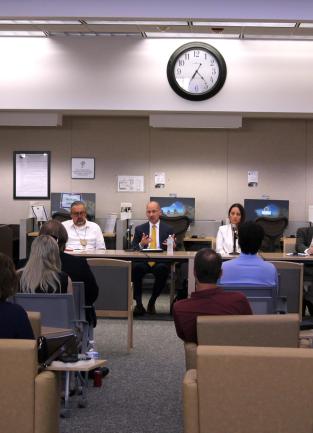
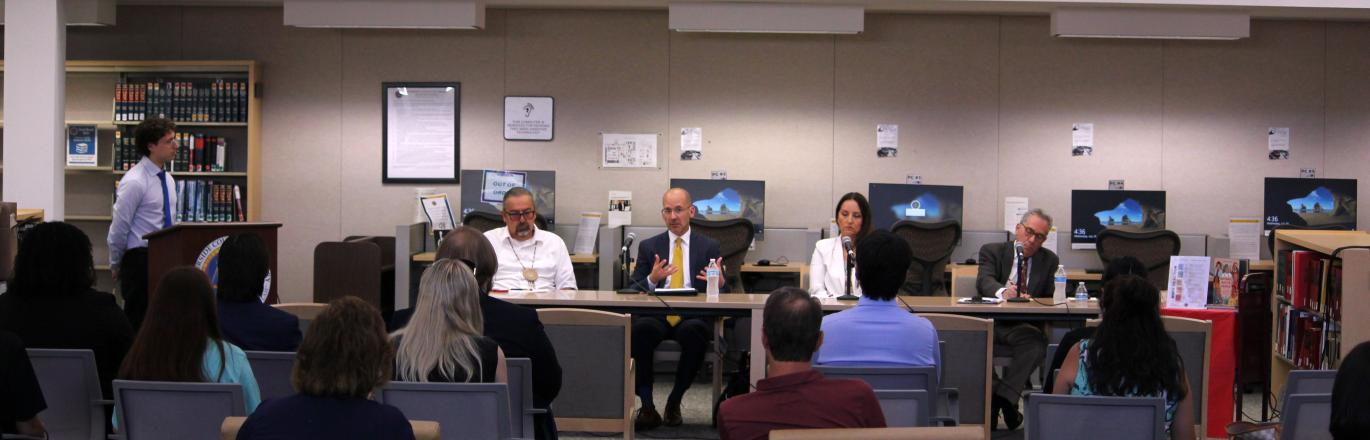
The below is a transcript of a panel discussion exploring the past present and future of Tribal Sovereignty. The transcript has been edited for ease of reading. The full discussion can be found here: https://youtu.be/GXR909auIaY. Photos from this event and our other 2026 Book to Action programs are available here: https://rclawlibrary.org/book-action-2026-events
Andy Valencia (Librarian): My name is Andy and I am the User Experience Librarian here at the Riverside County Law Library, and we're very happy to be hosting today's event. This year our library was selected as a recipient for the Youth and Family First Partner Book to Action grant. Over the past few weeks, the Riverside County Law Library has been conducting programming associated with Native American perspectives. This grant takes the idea of a book club, but instead of just talking about ideas, the aim is to encourage libraries to take those ideas and engage the community with them.
For our teen programming, we chose Notable Native People by Adrienne Keene. For our adult programming, we chose By the Fire We Carry by Rebecca Nagle. We held book discussions on both of these titles and now we're heading into the community engagement phase with two speaking engagements and a storytelling contest. Before I get started today, we would also like to acknowledge that the city of Riverside stands on traditional ancestral lands of the Cahuilla Nation.
Our first public speaking event is our panel discussion. Next week we will be announcing the winner of our teen storytelling contest and awarding them with a $500 scholarship. Submissions are still open! We'll wrap up on August 14th at the Palm Springs Law Library with a speaker from the Agua Caliente Band of Cahuilla Indians.
Without further ado, I'd like to introduce today's panelists:
Mark Vezzola: Deputy General Counsel of the Pechanga Band of Indians.
Professor Gerald Clarke: Citizen of the Cahuilla Band of Indians and professor of Ethnic Studies at UCR.
The Honorable Sunshine Sykes: US District Court Judge of the Central District of California.
Mark Radoff: Senior Staff Attorney for California Indian Legal Services.
Finally, I'd like to introduce you to your moderator this evening, Yanis Azzou.
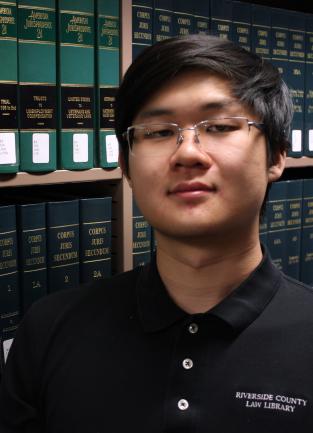
Yanis Azzou (Moderator): My name is Yanis, I'm a library assistant here. Thank you everyone for coming out and thank you to the panelists for your time and wisdom. Tribal sovereignty is a concept I've heard a lot about but never delved into deeply. After reading Rebecca Nagle’s book, I came out with more questions than answers. I hope to seek some clarity tonight. I'd like to invite each speaker to introduce themselves and their personal connection to tribal sovereignty.
Gerald Clarke: I’m an enrolled citizen of the Cahuilla Band of Indians and a professor at UCR. I was also elected to two terms on the Cahuilla Tribal Council. I’m not a lawyer, but through necessity, I’ve had to deal with sovereignty in my role as a tribal leader.
Mark Vezzola: I am the Deputy General Counsel for the Pechanga Band of Indians in Temecula. I went to law school at UCLA specifically to study federal Indian law. I've worked in this field for 20 years—as a court clerk for the Hopi Nation, an attorney at CILS, and a tribal court judge for the Pala and Chemehuevi tribes. Tribal sovereignty has been my guiding star in interpreting, drafting, and defending tribal laws.
Sunshine Sykes: I’m a District Court judge here in the Central District of California. I am a member of the Navajo Nation from Tuba City, Arizona. I started my career at California Indian Legal Services on a fellowship focused on domestic violence. I worked in juvenile dependency for most of my career, representing tribes, parents, and social services. I served 10 years as a state court judge in Riverside before being appointed to the federal bench by President Biden in 2022.
Mark Radoff: My name is Mark Radoff. I started out working for a legal aid program on the Navajo reservation and eventually moved back to California. I’ve worked for tribes and individuals, doing dependency work and serving as a tribal court judge. Sovereignty is a tricky term because it involves both the tribe as a whole and individual rights in relation to the tribe.
Yanis Azzou: Let's dive in. What is tribal sovereignty in your experience and how do you advocate for it currently?
Gerald Clarke: It depends on who you ask. Often non-native people see it as a "privilege" or "gift" from the government. People ask, "When did the government give land to the Cahuilla?" It wasn't given; it was reserved by our ancestors. For me, sovereignty is a responsibility to preserve and protect the land, people, and culture. We have to constantly educate even our own members because this responsibility is under constant threat.
Mark Vezzola: Sovereignty is inherent. It predates the Declaration of Independence. It is the right to be self-governing. In my job, I look at every contract or grant through the lens of protecting the tribe’s will. At Pechanga, the "General Council” —all adult members—is the governing body. They vote on laws and major business decisions. That is sovereignty in action.
Sunshine Sykes: As a judge, I’m not an advocate, but I ensure the law is applied fairly. Sovereignty is something tribes have always possessed and continue to exercise daily. My first experience was with the Indian Child Welfare Act [ICWA], ensuring tribes have a voice when native children are removed from their homes to keep them connected to their culture. Now, I see it as my responsibility to educate other judges who may not understand that tribes have legitimate, functioning governments and courts.
Mark Radoff: It’s a misunderstood concept. It’s like the Colorado River—you don’t "grant" it the ability to flow; it was already there. It covers everything from hunting and fishing rights to the government-to-government relationship. It’s an insult to treat a tribe like a county or a "parks and rec" department. A big piece is sovereign immunity, the idea that the nation cannot be sued without consent. It's a battle every step of the way to determine which laws apply.
Yanis Azzou: What continuities do you see between how nations governed themselves before colonization and today?
Gerald Clarke: Traditionally, Cahuilla had a net [leader] and a paham [assistant]. It wasn't a democracy in the Western sense, but a communal identity based on consensus. After a conflict in 1912 involving a BIA superintendent, a Western-style tribal council was forced upon us. While we use that system now, the "bullheaded" nature of our ancestors and our strong opinions have held true. We are seeing a move now toward hybrid versions that incorporate traditional family/clan representation.
Mark Vezzola: Pechanga has a three-part system: Trial Court, Appellate Court, and a Peacemaker Forum. The Peacemaker Forum is restorative justice. It's a direct line back to how the tribe resolved disputes through elders and wisdom to make everyone whole again, rather than the adversarial "winners and losers" model of Western courts.
Sunshine Sykes: Every tribe is different. Because they are sovereign, they can create any government they choose. Many tribes, like the Yurok, use peacemaking and youth courts that focus on restoring harmony. Instead of punitive punishment, a youth might be asked to give back to the community, like helping an elder. History matters here—understanding why laws like ICWA exist is crucial for judges and social workers to see that these aren't just "extra steps," but protections against historical efforts to destroy native families.
Mark Radoff: Custom and tradition have endured through oral history. In 1934, the Indian Reorganization Act tried to turn tribes into "little Americas" with written constitutions. Not every tribe opted in. The rules that were already there are now being understood better. ICWA was the moment we put our foot down against the historical practice of just taking children away to "convert" them.
Yanis Azzou: What are the goals for the next generation and what obstacles exist?
Gerald Clarke: Education. We have to raise our youth to understand this responsibility so they are ready for the battles they will confront as leaders.
Mark Vezzola: Vigilance. We cannot take sovereignty for granted. In the 1950s, the US government actively tried to "terminate" tribes to end financial obligations. People are still challenging the validity of tribal laws today.
Sunshine Sykes: We need more native attorneys, judges, and leaders. There are only five native federal judges in the US right now—and we're all women! We need to reach back and help our youth understand they have a place at the table.
Mark Radoff: We need to break the perception that tribal courts are "kangaroo courts." On the tribal side, we need to move away from "Robert's Rules of Order-ism"—using English rules for no reason.
Yanis Azzou: [Opening to Audience Q&A]
Audience Member: Are tribal men required to sign up for the draft?
Mark Radoff: Yes, they are. The federal government has imposed certain aspects of its system on tribal citizens, regardless of sovereignty.
Yanis Azzou (Reading Question from Zoom): How can indigenous nations build internal accountability without inheriting the corruption of federal politics?
Gerald Clarke: We never adopted a formal constitution; we govern by custom. Adapting is part of our evolution and perseverance.
Mark Vezzola: Pechanga's government is of the people, by the people. The General Council has the power to call leaders to task and remove them. Transparency is built into the membership structure.
Yanis Azzou (Reading Question from Zoom): What is the future of tribal courts having larger jurisdiction in criminal matters on reservation lands?
Mark Vezzola: It's complicated. In "Public Law 280" states like California, the state was given criminal jurisdiction over Indian lands. A 1978 Supreme Court case [Oliphant] devastatingly ruled that tribes don't have inherent criminal jurisdiction over non-Indians. However, the Violence Against Women Act [VAWA] has started to expand that jurisdiction.
Mark Radoff: There was a case in Bishop where a tribal officer detained someone with a warrant, and when the sheriff arrived, they arrested the tribal officer instead. It's a work in progress.
Gerald Clarke: I once had a stolen welder blocking a road on the reservation. The Sheriff said it was the Highway Patrol's problem; the Highway Patrol said it was the Sheriff's. I ended up just getting my tractor and moving it myself. Navigating that ignorance is the daily reality of tribal leadership.
Yanis Azzou (Reading Question from Zoom): Please advocate for ICWA training for all judges and attorneys.
Sunshine Sykes: We agree. It should be a required course in law school, not just an elective.
Gerald Clarke: We encourage our youth through tribal scholarships and education committees that didn't exist when I was young.
Mark Vezzola: Pechanga offers internships for youth to learn how the government works and instill a desire to give back.
Sunshine Sykes: As citizens, we have a responsibility to reach back. If we have a seat at a table that wasn't built for us, we must save room for others.