Far From Home, Yet Not Far Off: A Visit to the Alaska State Library
June 1, 2026
You cannot drive to Juneau. The Alaskan capital—home to a population roughly a tenth of the City of Riverside’s—is accessible only by plane or boat, with no roads connecting it to the rest of the state. Internet and cell service disappear completely at the region’s forested extremities, a reminder that such modern comforts are not as ubiquitous as they may feel. And so, when I found myself at the Alaska State Library in early May, I was eager to document the experience for those who might never have need to visit a city so remote.
The Alaska State Library, Archives, and Museum are all housed in the two-story Father Andrew P. Kashevaroff (APK) building in Juneau’s small urban center. Outside stands “Nimbus,” a sculpture by artist Robert Murray. The bright teal, folded shape is both a striking abstraction of the Arctic climate and a point of local contention; “People here either love it or hate it. I love it,” said Rob Roys, the Juneau artist who had driven me from the airport. Seconds later he excused himself to sign the petition of a canvasser he knew, a moment that nicely demonstrated both the closeness and civic engagement of this community.
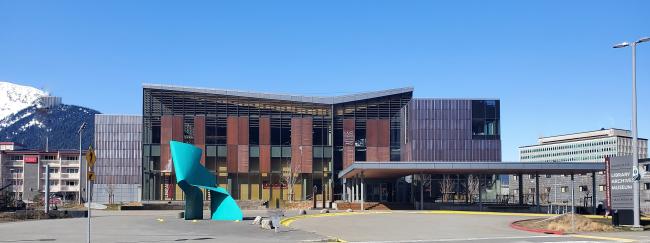
(Photo courtesy of Travel Juneau)
Constructed in 2016 where once only the State Museum stood, the APK building features the sleek, light-wood-paneled aesthetic common to many modern cultural institutions (including our renovated Riverside Branch). To the right of the entrance are a café, lecture rooms, and an observable conservation lab. To the left is the Alaska State Museum, a remarkable collection of thousands of artworks, artifacts, and technology from pre-colonial Indigenous cultures through the modern day. Of particular note were an impressive Alaska Gastineau Mining Company locomotive and a temporary exhibit showcasing fashion by Haida designer Dorothy Grant.
In contrast to the winding museum below, the Library and Archives reside in a single large room on the second floor. The materials of the State Archives sit near the entrance, greeting visitors with a hulking microfiche reader akin to the one held in Riverside until 2022. Behind are two smaller, more modern microfilm reading stations near a row of black cabinets containing newspaper archives and microfilm documents. Additional cabinets line the left wall around an open area of study tables. The right wall, beyond which sits additional research/study space, is adorned by a stained-glass mural depicting Alaskan sea life and Native fishers. A row each of half and full-height stacks, some shelves along the back wall, and a circulation desk (yes, they circulate!) make up the proper State Library portion of the room.
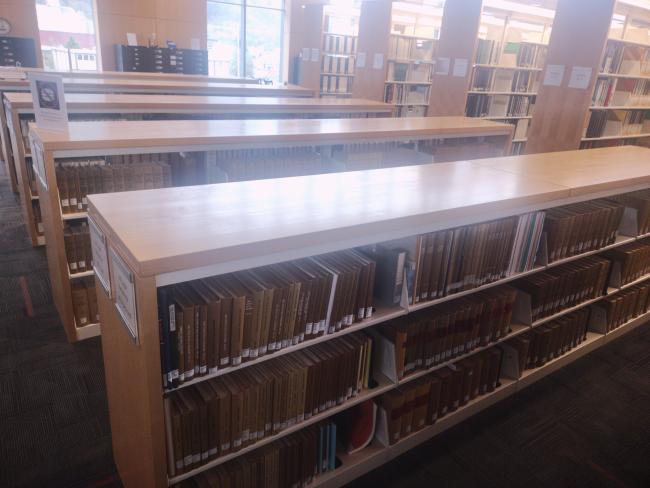
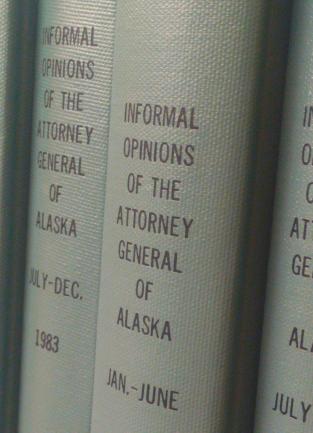
I did not anticipate finding more than a few legal texts, if any, largely because I had been under the misconception that I would be visiting a standard public library. Thus, I was very pleasantly surprised to find the half-stacks—past a charming display about the Alaska Railroad—to be nearly entirely devoted to the law: iterations of the Alaska Statutes, series of West’s Alaska Reporter, and various agency reports. The Alaska Statutes are comprised of twelve volumes and a few supplements; a stark contrast to the 400-plus volume sets of California Codes held at RCLL. Atop one shelf sat a set unlike anything in our collection: six massive atlases of Alaska’s waters prepared by the Department of Fish and Game.
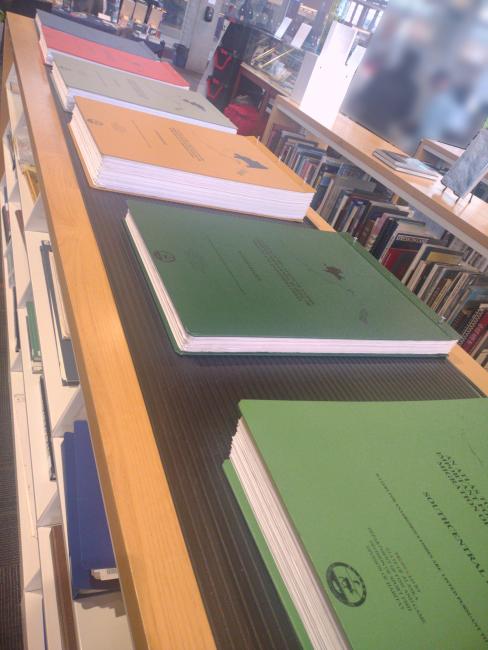
These titanic tomes reflect one of the two issues most prominent among the Alaska State Library’s legal holdings: environmental law and Indigenous history. The general stacks carry several series of land use and natural resource-related decisions, as well as volumes of treaties with Native tribes. The remaining books are primarily legal histories, such as the eye-catching title BONG HiTS 4 JESUS, an account of the Supreme Court case Morse v. Frederick (51 U.S. 393 2007) that began in Juneau. Federal materials, including case reporters and Congressional histories, fill the shelves against the back wall. Beyond a few familiar Nolo titles, the collection did not appear to include any practice guides; those could likely be found at the Juneau Law Library a few streets away, which was unfortunately closed during my time in town.
As I took in the rows of Alaska texts, marked “KFA” under the Library of Congress classification system, I wondered whether any California-related books had found their way up here. At the end of the legal section I found one solitary title bearing the familiar “KFC” prefix: The Implementation of the California Determinate Sentencing Law, published by the National Institute of Justice in 1992. I have since learned that, humorously, this is one book RCLL lacks!
My overall visit to Alaska was a wonderful experience, although one I wouldn’t had envisioned just a few years ago. Before I arrived, my concept of the 49th state was unclear, largely shaped by popular depictions of the far North as harsh, snow-covered, and sparsely populated. I hope that this account can help those with a similar impression form a more solid picture of Alaska and its institutions. Should you ever find yourself three thousand miles away in Juneau, pop into the Alaska State Library—you might feel more at home than you expect.
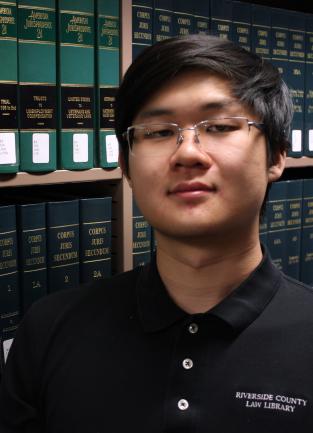
By Matthew Palacios, Library Assistant